Bashir Eskandari Highlights the Role of Diaspora Communities from Afghanistan in Responding to the Taliban Takeover at European Conference in Brussels
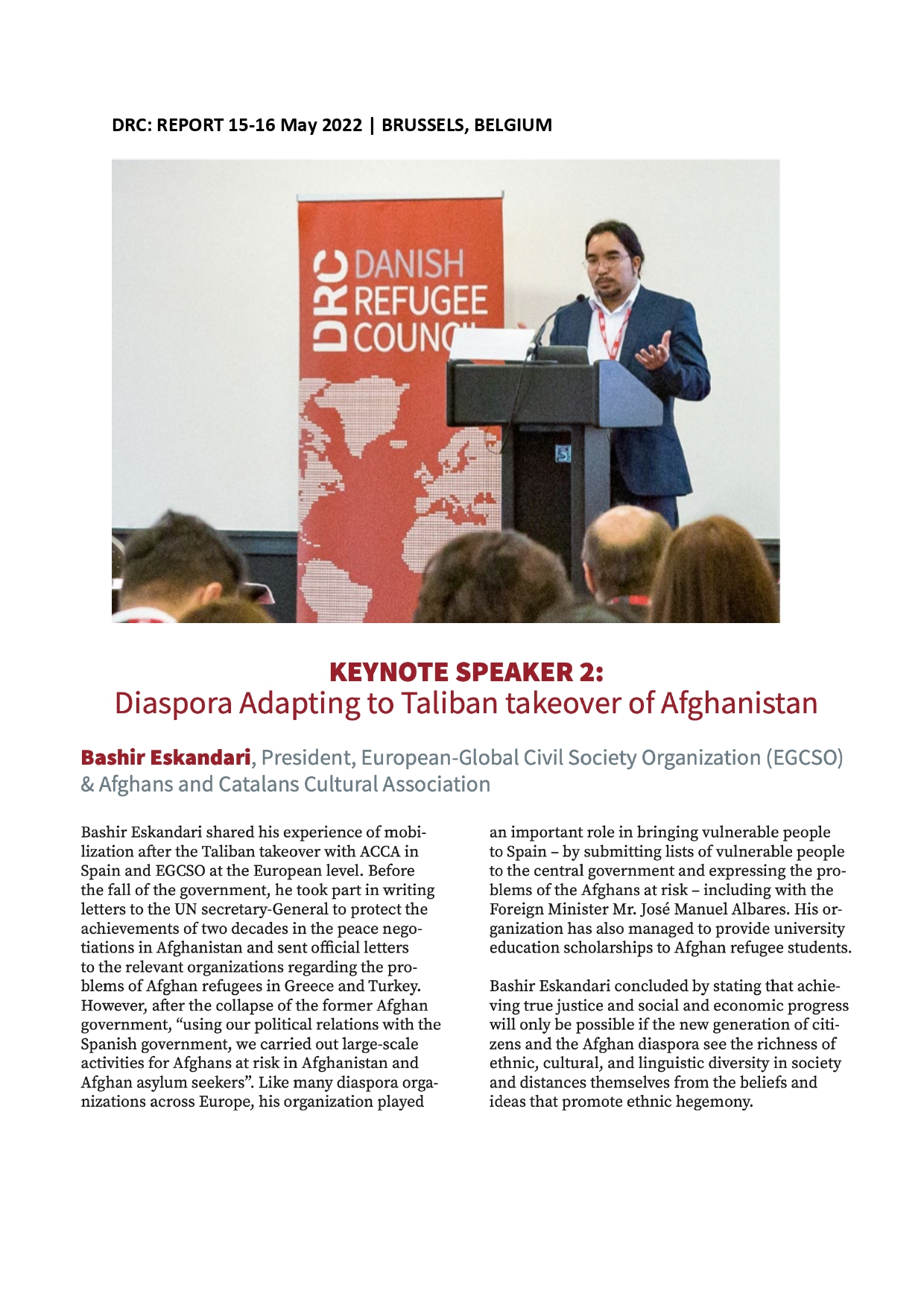
The role of diaspora organisations after August 2021
During his presentation, Eskandari shared the experience of EGCSO and the Afghans and Catalans Cultural Association in mobilising support for Afghans before and after the collapse of the former Afghan government in August 2021.
He explained that the organisation had been active since 2020, working with civil society representatives, human rights advocates, researchers and migrant communities. Its activities extended beyond Spain through cooperation with individuals and organisations in several European countries, as well as contacts with partners in the United States, Australia and Asia.
Before the Taliban takeover, the organisation had participated in initiatives aimed at protecting the achievements of two decades in Afghanistan. These included sending letters to the United Nations Secretary-General during the peace negotiations and raising concerns about the situation of Afghan refugees and asylum seekers in countries such as Greece and Turkey.
Following the collapse of the Afghan government, EGCSO and its partner association adapted their work to the urgent needs of people at risk. Eskandari described how the organisations used their political and institutional contacts in Spain to raise the cases of vulnerable Afghans and advocate for their evacuation and protection.
Advocacy and cooperation with Spanish authorities
Eskandari explained that the organisation submitted lists of vulnerable individuals to the relevant Spanish authorities, communicated their circumstances to government representatives and called for greater attention to Afghans facing immediate danger.
This work included meetings and communication with Spanish government representatives, including the Minister of Foreign Affairs, José Manuel Albares. The organisation also organised four public demonstrations to draw attention to the situation in Afghanistan and encourage the authorities to respond to the needs of people at risk.
He also referred to the organisation’s engagement with Spanish officials and representatives involved in evacuation and consular operations. In November 2021, EGCSO and its partner association held a meeting with representatives connected to Spain’s military and diplomatic response to the Afghanistan evacuation. During these discussions, the organisation presented additional information about vulnerable individuals and communities requiring protection.
Eskandari highlighted the importance of maintaining communication with government institutions and using existing political relationships to advocate for people who might otherwise remain excluded from protection and evacuation processes.
Supporting Afghan refugees and students
Beyond emergency advocacy and evacuation efforts, Eskandari emphasised the importance of supporting the long-term integration and future of Afghan refugees in Europe.
EGCSO worked with local authorities in Catalonia, municipalities and civil society organisations to address the practical needs of newly arrived Afghans. These activities included cooperation with organisations providing humanitarian assistance, legal guidance, interpretation and support for refugees and asylum seekers.
He also discussed the organisation’s efforts to facilitate access to higher education for Afghan refugee students. Through contacts with universities in Catalonia, including the Autonomous University of Barcelona (UAB), the organisation worked to create opportunities for Afghan students to continue their education.
These efforts also addressed difficulties faced by students whose academic documents could not be verified through the usual Afghan government procedures. The organisation advocated for alternative ways to assess their qualifications so that administrative obstacles would not prevent them from pursuing university studies.
Building cooperation across Europe and beyond
A central point of Eskandari’s presentation was that the Afghan diaspora should not operate in isolation. He described EGCSO as an organisation seeking to connect Afghan associations, civil society activists and human rights advocates across national borders.
The organisation’s network included contacts and representatives in countries such as Greece, Sweden, Norway, Austria, Italy, the United Kingdom, the United States and Turkey. Eskandari also referred to cooperation with networks such as the Afghan Refugees Experts Network in Europe (ARENE).
He outlined three broad areas of activity:
- Local cooperation: Working with migrant communities, cultural associations and civil society organisations to address social needs and promote participation in local communities.
- Cooperation with regional and municipal authorities: Engaging with local institutions, particularly in Catalonia, to improve support for newly arrived refugees and vulnerable people.
- National and international advocacy: Maintaining contact with central government institutions, coordinating with Afghan organisations and experts abroad, and building cooperation with civil society networks in Europe and other regions.
Eskandari stressed that diaspora organisations have an important responsibility to contribute their experience, professional knowledge and political connections to the protection of Afghan communities.
The political and humanitarian situation in Afghanistan
In the second part of his presentation, Eskandari addressed the situation in Afghanistan under Taliban rule. He argued that the country’s political, economic and educational institutions had suffered a profound collapse and that the population was facing widespread poverty, insecurity and a lack of basic opportunities.
He challenged the idea that the Taliban’s military control should automatically be understood as legitimate political authority. In his analysis, political legitimacy requires public consent, legal recognition and institutions capable of representing the country’s population. He argued that the Taliban lacked these foundations.
He also questioned the Taliban’s political and ideological model, describing it as incompatible with the needs of a diverse, multi-ethnic society and with modern principles of inclusive governance and equal citizenship.
Concerns over the exclusion and persecution of ethnic communities
Eskandari drew particular attention to the situation of the Hazara community, including its exclusion from political structures, economic marginalisation, security threats and continued reports of targeted violence.
He referred to attacks against Hazara civilians in places of worship, educational institutions, public spaces and along transport routes. He also raised concerns about threats and violence affecting Hazara communities in areas including Nahur and Behsud, where disputes and attacks involving nomadic Kuchi groups had created further insecurity for local residents.
Addressing the historical background, Eskandari referred to the mass violence committed against Hazaras during the rule of Amir Abdur Rahman Khan in the late nineteenth century. He argued that the historical persecution of Hazaras and the continuing discrimination against ethnic communities must be examined as part of Afghanistan’s wider political and social history.
His presentation also raised concerns about violence and insecurity affecting Tajik communities, including reports from Panjshir, Andarab and Takhar. He emphasised that the protection of civilians and the rights of all ethnic and religious communities must be central to any discussion about Afghanistan’s future.
A vision for an inclusive and democratic Afghanistan
In the concluding part of his presentation, Eskandari argued that Afghanistan’s national identity cannot be built through ethnic dominance, forced assimilation or the exclusion of cultural and linguistic communities.
He stressed that every community should be able to see its history, culture, language and values reflected in the country’s national identity. In his view, an inclusive national framework must guarantee equal citizenship and prevent any group from being forced to abandon its identity in order to participate in public life.
Eskandari also called on the Taliban to respond to the demands of Afghanistan’s people and the international community by establishing an inclusive national government involving the country’s different communities and political groups, recognising women’s rights and ending support for terrorist organisations.
The responsibility of the Afghan diaspora
Eskandari concluded by emphasising that the Afghan diaspora has a role beyond providing emergency assistance. It can contribute to political advocacy, international cooperation, the protection of human rights and the development of a more inclusive vision for Afghanistan.
He called on diaspora organisations and the younger generation to work together, overcome divisions and use their experience and networks to support vulnerable people and promote democratic values, equal rights and social justice.
His contribution at the Brussels conference presented EGCSO’s experience as an example of how diaspora organisations can combine local community work, institutional engagement and international advocacy in response to a major political and humanitarian crisis.
Session: Keynote Speaker 2 — Diaspora Adapting to Taliban Takeover of Afghanistan
Speaker: Bashir Eskandari, President of EGCSO and the Afghans and Catalans Cultural Association
Location: Brussels, Belgium
Date: 15–16 May 2022